
Diwali Diya Guide: Ghee, Oil, Cotton Wicks & Kapoor
Diyas are one of the most familiar parts of Diwali celebrations, but preparing them often raises practical questions. Should you use ghee or oil? Which cotton wick suits your diya? How much fuel should you add? Why does a diya sometimes go out or produce smoke? And where does kapoor fit into the puja?
This Diwali diya guide focuses on those practical questions. It explains how ghee and oil differ in everyday use, how to choose and position cotton wicks, how to prepare a diya step by step, what may cause common flame problems, and how to use kapoor safely for aarti.
Diya traditions vary by family, region, deity and sampradaya. If your household follows an established practice, that tradition should take priority over general online advice.
What Do You Need to Prepare a Diwali Diya?
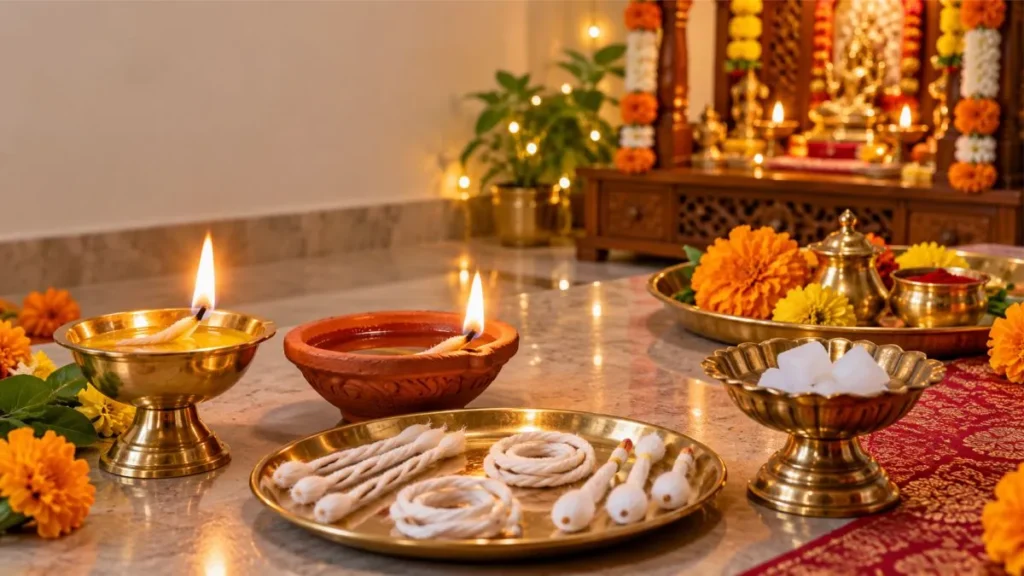
For a simple diya setup, keep these basics ready:
- Clean, stable diya
- Cotton wick
- Puja ghee or puja oil used in your household
- Matchbox or lighter
- Stable, heat-resistant surface
You may also keep extra diyas, spare wicks and kapoor for aarti nearby.
Kapoor is treated separately in this guide because established puja references distinguish dīpa, the lamp offering, from karpūra-nīrājana, the final waving of a camphor flame. That supports treating camphor primarily as a separate aarti item rather than assuming it must be mixed into every diya. Hindu American Foundation
For the rest of your Diwali preparation, use the separate Diwali Puja Samagri List for the full inventory and the Diwali Puja Thali Guide for arranging the working puja tray.
Ghee or Oil for Diwali Diya: Which Should You Use?
Both ghee and oil are used for diyas in Indian worship traditions.
There is no need to declare one universally better. Your choice can depend on family custom, diya design, the number of lamps being prepared and how the diya will be used.
| Factor | Ghee Diya | Oil Diya |
|---|---|---|
| Common practical use | Main puja diya and other household worship where followed | Puja and multiple/decorative diyas where followed |
| Physical form | Can be liquid, semi-solid or firm depending on temperature | Liquid |
| Wick preparation | Wick must maintain continuous contact with the ghee | Wick generally draws liquid oil readily |
| Multiple-diya preparation | Practical for smaller numbers depending on setup | Often convenient when preparing several diyas |
| Burn duration | Depends on diya, wick, fuel amount and conditions | Depends on diya, wick, fuel amount and conditions |
| Best choice | Follow household tradition and practical need | Follow household tradition and practical need |
Exact burn time cannot be predicted simply from “ghee versus oil.” Diya size, wick construction, exposed wick length, fuel quantity and airflow can all affect the flame.
Using Puja Ghee in a Diya
Many households use ghee for a main puja diya.
From a practical point of view:
- Use a diya that sits flat and securely.
- Position the cotton wick before lighting.
- Ensure the wick remains in continuous contact with the ghee.
- Avoid filling the diya so high that ghee can spill.
- If the ghee is firm, make sure enough of the wick is surrounded by or touching the fuel.
The wick should not merely have ghee on its exposed tip. It needs continued access to the fuel while the diya burns.
If using a commercial puja product, follow the actual label. SAV Products currently describes VARUN Pooja Ghee specifically as a product “For DIYA,” so it should be treated as diya/ritual-use puja ghee unless the product packaging explicitly states any additional use. SAV Products – VARUN®
Using Puja Oil in a Diya
Oil is also commonly used for Diwali diyas.
It can be convenient when preparing several lamps because it is liquid and easy to portion. Cotton wicks generally draw liquid fuel readily once properly positioned.
A practical process is:
- Place the wick.
- Add a moderate amount of oil.
- Allow the wick to take up the oil.
- Check that the lighting end is not excessively long.
- Light only after the diya is in its final safe position.
The type of oil traditionally used can vary widely between households and regions, so no single oil should be presented as compulsory for all Diwali worship.
SAV Products currently lists VARUN Pooja Oil as a diya-lighting product. SAV Products – VARUN®
Ghee Diya vs Oil Diya: Quick Decision Guide
If you are unsure which to use, consider these factors.
1. Family Tradition
Start with the practice already followed in your home.
A long-standing household tradition does not need to be changed simply because an article online says one fuel is “more auspicious” or “better.”
2. Purpose of the Diya
Some households use one type of diya for the mandir and another for additional lamps around the home.
3. Number of Diyas
Preparing one main puja diya is different from preparing 20 or 30 lamps.
4. Diya Size
A small clay diya and a larger brass lamp require different amounts of fuel and different wick proportions.
5. Wick
The wick affects the flame as much as the fuel does.
6. Desired Practical Duration
If a lamp needs to remain lit longer, use a suitable diya with an appropriate amount of fuel rather than overfilling a very small lamp.
Avoid exact “one teaspoon = X minutes” type claims unless the exact diya, wick, fuel and conditions have actually been tested.
Which Cotton Wick Should You Use?
A suitable cotton wick should match the size and design of the diya.
As practical guidance, look for a wick that is:
- Clean
- Dry before preparation
- Appropriately sized for the diya
- Able to remain in steady contact with the fuel
- Not so large that it creates an unnecessarily large flame
- Long enough to position securely
There is no single universally “best” wick thickness.
Cotton density, twisting, wick shape, diya geometry and the type of fuel all influence how the lamp behaves.
Common Types of Cotton Wicks
Long Cotton Wick
A long wick is commonly used in open clay or metal diyas.
One portion remains inside the fuel while the lighting end rests near the diya’s edge or spout.
This design also makes the exposed length easier to adjust.
Round or Flower-Style Wick
Some households use rounded or flower-style wicks, particularly with lamps designed for central wick placement.
Their use depends on lamp design and family tradition.
Handmade Cotton Wick
Loose cotton can also be rolled manually.
This gives the household control over wick length and thickness, although consistent sizing becomes important when preparing many diyas together.
How Much Wick Should Be Exposed?
Only a controlled portion of the wick needs to extend above the fuel.
Too much exposed wick can contribute to:
- A larger flame
- Faster fuel consumption
- Uneven burning
- Smoking or soot
Those effects are not determined by wick length alone. Fuel characteristics and airflow also matter.
If the flame is larger than expected, extinguish the diya safely before adjusting the wick.
How to Prepare a Diya Step by Step
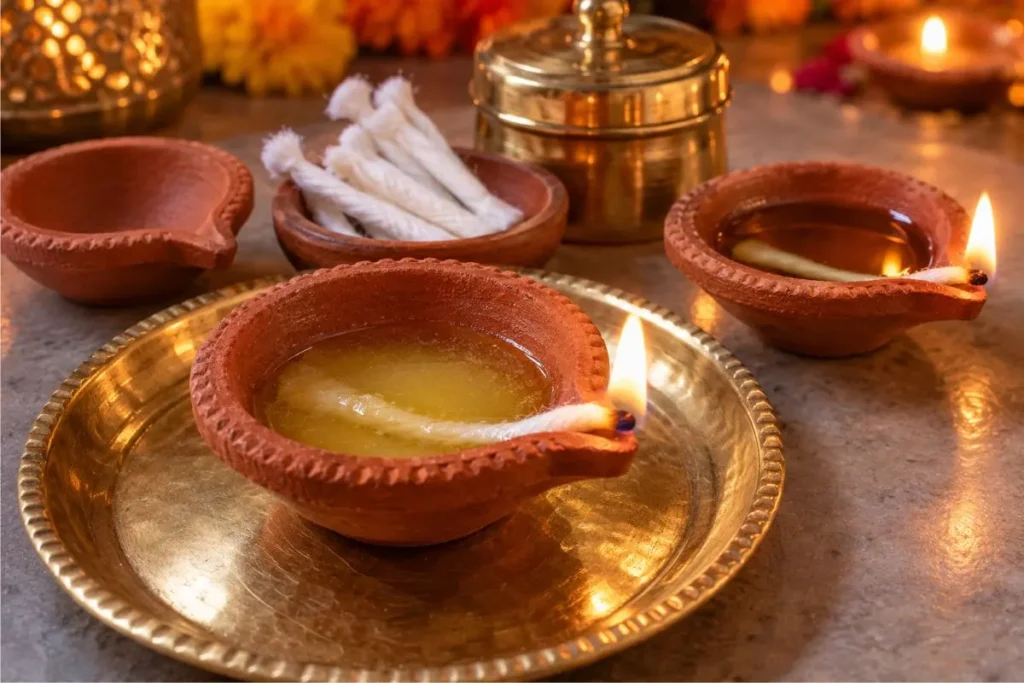
Step 1: Inspect the Diya
Before adding fuel:
- Make sure the diya is clean.
- Make sure it is dry.
- Check clay diyas for visible cracks.
- Confirm that the base sits flat.
A cracked or unstable diya should be replaced.
Step 2: Position the Wick
Place the wick according to the diya design.
The inner portion should remain in contact with the ghee or oil while a small lighting end remains exposed.
Step 3: Add Ghee or Oil
Add enough fuel to keep the wick supplied.
Avoid filling the diya so high that fuel can easily spill if the lamp is moved or touched.
Step 4: Prepare the Wick
For oil:
Allow the wick to absorb enough liquid fuel before lighting.
For ghee:
Ensure the wick has continuous contact with the ghee, particularly if the ghee is firm or semi-solid.
Step 5: Check the Exposed Tip
If a large amount of dry wick is protruding above the fuel line, shorten or reposition it before lighting.
Step 6: Place the Diya
Move the diya to its intended location before lighting wherever practical.
Use a stable, heat-resistant surface away from curtains, paper, loose fabric and busy walking areas.
Step 7: Light and Observe
Light the wick carefully and observe it briefly.
If the flame is unusually large, weak or unstable, extinguish the diya before adjusting it.
How Much Ghee or Oil Should You Put in a Diya?
There is no universal measurement.
The appropriate quantity depends on:
- Diya capacity
- Wick size
- Number of wicks
- Fuel type
- Diya shape
- Intended use
The safest practical principle is simple:
Use enough fuel to supply the wick without overfilling the diya.
For longer lighting, choose an appropriately sized lamp instead of filling a small diya to the edge.
Important: Never Refill a Burning Diya
Do not pour or add ghee or oil while the diya is burning.
If more fuel is needed:
- Extinguish the flame safely.
- Allow the diya to become safe to handle.
- Add the fuel carefully.
- Reposition the wick if necessary.
- Relight only after the diya is stable.
Keep the main ghee or oil container securely closed and away from burning diyas.
Delhi Fire Service advises keeping oil lamps and other open flames away from combustible materials, keeping matches and lighters away from children and never leaving open fire unattended. Its household fire guidance also warns against refilling an appliance while it is burning, reinforcing the importance of refilling only after the flame is out. Department of Delhi Fire Service
Why Does My Diya Keep Going Out?
Common possible causes include the following.
Wick Is Too Dry
A dry wick may light briefly but fail to sustain the flame.
What to try: Extinguish if necessary and make sure the wick has absorbed oil or remains properly connected to the ghee.
Too Little Fuel
The wick may no longer be reaching the available fuel.
What to try: Extinguish the diya and refill it safely.
Wick Tip Is Too Short
A very small exposed section may make lighting difficult.
What to try: Once the diya is extinguished, adjust the wick slightly.
Wick Is Too Large for the Diya
An oversized wick can sometimes create an unnecessarily large or unstable flame and use fuel quickly.
What to try: Use a wick better proportioned to the lamp.
Wick Has Shifted
Moving the lamp can change the wick’s position.
What to try: Extinguish the diya and restore proper wick-to-fuel contact.
Strong Drafts
Fans, open windows and balcony wind can destabilize or extinguish a small flame.
What to try: Move the diya to a safer location protected from strong airflow.
Moisture, Dirt or Other Factors
Lamp condition, wick condition, fuel and diya geometry can also affect performance.
Troubleshooting should therefore begin with the simplest checks rather than assuming one cause every time.
Why Is My Diya Smoking or Producing Soot?
Possible contributors include:
- Excessive exposed wick
- A wick that is too large for the diya
- An unstable flame
- Strong or irregular drafts
- Foreign material in the lamp
- A dirty diya
- Fuel not intended for the intended lamp use
Try reducing the exposed wick, cleaning the diya and protecting the flame from strong drafts.
Strong airflow does not always affect combustion in exactly the same way, but it can disturb the flame and contribute to uneven burning or smoking.
Do not describe a diya, fuel or wick as completely “smokeless” unless that claim is supported by appropriate testing.
Why Is My Diya Burning Too Fast?
Possible causes can include:
- Too much wick exposed
- Wick larger than needed for the diya
- Very little fuel relative to the wick
- Drafts altering the flame
- Lamp design exposing a large part of the wick
A controlled flame generally gives a more manageable diya than deliberately extending the wick to create the largest possible flame.
Where Does Kapoor Fit Into Diwali Puja?
Kapoor is commonly used separately for aarti in many households.
A puja guide from Hindu American Foundation lists the lamp offering, dīpa, separately from karpūra-nīrājana, the final camphor flame. Hindu American Foundation
This does not mean every household follows exactly the same sequence.
It does mean there is no need to assume camphor must be mixed into each ghee or oil diya.
Where camphor aarti forms part of the household tradition, it can be burned in:
- A suitable camphor holder
- An appropriate aarti plate
- Another holder used safely according to family practice
Diya vs Kapoor Aarti
| Diya | Kapoor / Camphor |
|---|---|
| Normally uses a cotton wick | Camphor can be burned directly in a suitable holder |
| Uses ghee or oil as fuel | Camphor itself burns |
| Used as a lamp during puja and festive lighting | Commonly used for aarti in many households |
| Can remain lit as a continuing lamp | Typically used as a brief aarti flame |
These are practical distinctions, not universal ritual rules.
How Many Diyas Should You Light on Diwali?
There is no single compulsory number for every Hindu household.
Some families may light:
- One principal puja diya
- Diyas around the mandir
- Lamps near the entrance
- Additional lamps in a courtyard or balcony
- A traditional number followed by the family
Numbers such as 5, 11, 21 or 51 may appear in different customs, but they should not be presented as universally mandatory.
Light only the number your household can manage safely.
Where Can Diwali Diyas Be Placed?
Depending on household practice and available space, diyas may be placed in areas such as:
- Home mandir
- Entrance
- Courtyard
- Designated festive areas
- Balcony, where genuinely safe
Elevated ledges, balconies and windows require particular care.
Use them only where the surface is stable and non-combustible, the diya is protected from strong drafts, there is no curtain or loose decoration nearby and there is no realistic chance of the lamp being knocked or falling.
Otherwise, choose a safer location.
Avoid:
- Unstable ledges
- Busy pathways
- Windy locations
- Areas reachable by children or pets
- Locations beside curtains or paper decorations
Preparing Multiple Diyas for Diwali
If you plan to light many diyas, preparation in advance can reduce last-minute work.
Practical Preparation: 1–2 Days Before
You can:
- Count the diyas.
- Inspect clay lamps for cracks.
- Clean reusable diyas.
- Prepare or organize cotton wicks.
- Check ghee or oil stock.
- Keep spare wicks ready.
- Decide where the diyas can be placed safely.
This is an organizational suggestion, not a religious timeline.
On Diwali Day
Group the diyas according to use:
Puja diyas: for the mandir or Lakshmi-Ganesh Puja.
Entrance diyas: for designated doorway areas.
Decorative diyas: for other safe festival locations.
Wicks can be positioned in advance if convenient, while fuel can be added closer to lighting time.
Diwali Diya Safety Tips
Open flames require active supervision.
- Place diyas on stable, heat-resistant surfaces.
- Keep them away from curtains, paper and other combustible materials.
- Keep loose clothing away from flames.
- Supervise children around burning lamps.
- Keep pets away from diya areas.
- Never leave lit diyas unattended.
- Do not overfill them.
- Never add oil or ghee while a diya is burning.
- Keep spare fuel bottles or containers closed and away from flames.
- Avoid carrying a hot or burning diya unnecessarily.
- Use a suitable holder for burning camphor.
- Keep matches and lighters away from children.
Delhi Fire Service specifically advises against placing oil lamps, agarbattis or candles close to combustible materials and says open fire should never be left unattended. Department of Delhi Fire Service
How to Store Leftover Diya Essentials
Puja Ghee
Follow the storage directions printed on the product label.
Keep the container properly closed when not in use.
If the product is labelled specifically for diya or ritual use, do not use it as food or naivedya unless the packaging explicitly states that it is suitable for human consumption.
Puja Oil
Keep the bottle securely closed and follow its label instructions.
Store it away from open flames.
Cotton Wicks
Keep unused cotton wicks:
- Clean
- Dry
- Covered
- Away from moisture and dust
Pooja Camphor
Keep camphor:
- In a tightly closed container
- Away from heat
- Away from open flame
- Out of children’s reach
- According to the packaging instructions
Do not invent shelf life or expiry periods. Use the manufacturer’s actual label.
Common Diwali Diya Mistakes
Using a Wick Too Large for the Diya
A very large wick can contribute to an unnecessarily large flame and rapid fuel use.
Leaving Too Much Wick Exposed
More exposed wick does not automatically mean a better diya.
Overfilling
An overfilled diya is easier to spill and harder to handle safely.
Lighting a Dry Wick
Make sure the wick has access to the fuel before lighting.
Adjusting a Burning Diya
Extinguish it before repositioning the wick or adding fuel.
Choosing an Unstable Surface
The diya should sit flat without wobbling.
Treating One Tradition as Universal
Ghee versus oil, wick style, number of diyas and diya placement can differ between households.
Leaving Diyas Unattended
This is one of the simplest avoidable risks.
Ghee, Oil, Cotton Wick & Kapoor at a Glance
| Item | Main Practical Role |
|---|---|
| Puja Ghee | Diya fuel where traditionally used |
| Puja Oil | Diya fuel where traditionally used |
| Cotton Wick | Draws fuel to support the flame |
| Pooja Camphor | Commonly used separately for aarti |
| Diya | Holds the wick and fuel |
VARUN Diya and Aarti Essentials
SAV Products currently lists puja products including Pooja Ghee for Diya, Pooja Oil for Diya, Pooja Camphor and Cotton Wick. SAV Products – VARUN®
For Diwali diya preparation, these products can be considered where they match your normal household practice:
- VARUN Pooja Ghee — labelled for diya use
- VARUN Pooja Oil — for diya/lamp use
- VARUN Cotton Wick
- VARUN Pooja Camphor — for households that use camphor in aarti
Use each item according to its actual packaging and intended purpose.
There is no need to infer performance, food suitability, burn time or religious properties that are not stated by the manufacturer.
Frequently Asked Questions
Is ghee or oil better for a Diwali diya?
Neither is universally better. Both are used in different household traditions. Choose according to family practice, diya type and practical requirements.
Can I use both ghee and oil diyas on Diwali?
Yes. Some households use ghee for one lamp and oil for other diyas. Follow your own family tradition.
Which cotton wick is best for Diwali?
Use a clean cotton wick that is proportionate to the diya and stays in contact with the fuel. Avoid exposing an unnecessarily long section of wick.
Why does my diya keep going out?
Possible causes include insufficient wick-to-fuel contact, too little fuel, unsuitable wick size, moisture or strong drafts.
Why is my diya producing black smoke?
Possible contributors include excessive wick exposure, an oversized wick, an unstable flame, dirt or foreign material, and irregular airflow.
How much ghee or oil should I add?
There is no fixed universal quantity. Add enough to supply the wick without overfilling the diya.
Can I refill a diya while it is burning?
No. Extinguish the diya first and allow it to become safe to handle before adding more fuel.
Can kapoor be put inside a diya?
Household traditions vary. Camphor is commonly used separately during aarti, and established puja guidance distinguishes the lamp offering from camphor aarti. Follow your family practice rather than assuming camphor must be added to every diya. Hindu American Foundation
How many diyas should be lit on Diwali?
There is no universal compulsory number. Follow your family’s tradition and use only as many diyas as you can supervise safely.
Can cotton wicks be prepared in advance?
Yes. Dry wicks can be prepared and stored in a clean, dry container before Diwali.
How should leftover ghee, oil and camphor be stored?
Follow the product label. Keep containers properly closed, cotton wicks dry and camphor away from heat and flame.
Final Thoughts
A reliable Diwali diya guide does not need complicated ritual claims.
The practical basics are simple: choose a stable diya, use the ghee or oil followed in your household, match the cotton wick to the lamp, maintain continuous wick-to-fuel contact and keep the flame controlled.
Treat kapoor as a separate aarti item where that matches your family tradition. Avoid overfilling, never refill a burning diya and keep spare fuel away from open flames.
Preparing diyas in advance can make Diwali evening easier, but household tradition should remain the guide for religious choices.
For the rest of the festival setup, use your Diwali Puja Samagri List, Diwali Puja Thali Guide and Daily Puja Samagri List for Home rather than expanding this page beyond its diya-specific purpose.